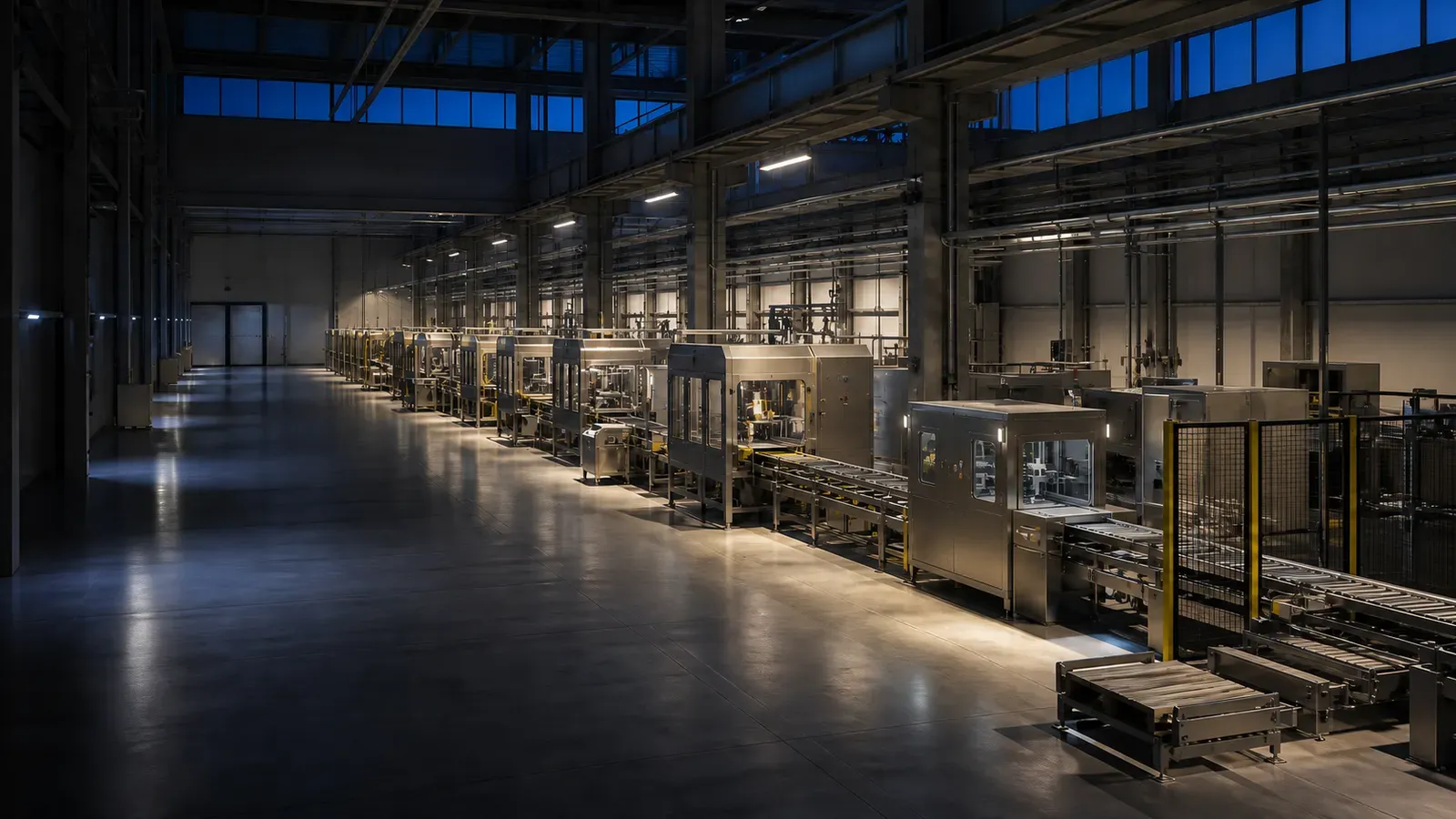
Introducing AI in an existing landscape
Software is a tool in your business. AI is a question of organisation.
We work with companies whose product is not made of code. Software supports a product or a service you deliver. What decides the outcome is ownership, data access and the approval chain.
Thirty minutes. Bring the current use, open decision or regulatory question. We identify the right entry point.
Diagnosis
Six points where it actually stalls
These six points come up regardless of sector and regardless of company age.
- 01AI stays at the edge of value creationThe applications run in marketing, sales and administration. In the core process, where your value is created, they rarely arrive.
- 02The applications run beside the core systemThe models work on copies and side systems, while the business data sits in ERP and in the plant. Every analysis needs its own bridge, and every bridge needs maintaining.
- 03Nobody owns it by defaultThere is no product organisation that would own digital work anyway. Every approval therefore becomes a single decision between IT, the business unit and the management board.
- 04Connecting to existing systems slows things downMachines, plant and grown systems do not speak the same language. Connecting them regularly costs more time than the model itself.
- 05Progress depends on other companies’ roadmapsAI mostly enters your company through suppliers and standard software. What you get, and when, is then set by their roadmap.
- 06Ownership is unregulated, the obligations apply anywayEU AI Act transparency duties apply to deployers as well, and NIS2 places personal duties on management. Internal rules for this are still missing in most companies.
The difference
Software as the product, software as a tool
We work for the right-hand side. If you want to see both side by side, open the comparison.
Open the comparison
What AI is built for
Software is the product
For the product that is sold.
Software is a tool
For the operation that makes the product or delivers the service.
Who owns it
Software is the product
The product organisation, which already exists.
Software is a tool
Changing groups from IT, the business unit and the management board.
Where the data sits
Software is the product
In your own systems, under your own control.
Software is a tool
In ERP, machines and plant, often with third parties.
How improvement spreads
Software is the product
Built once, live for every customer.
Software is a tool
Site by site, then shift by shift.
Who has a say
Software is the product
Product and engineering.
Software is a tool
IT security, data protection, works council, procurement.
What counts in the end
Software is the product
A release.
Software is a tool
One case running in daily operation.
From pilot to operations
Five stations between pilot and routine operation
Where software is the product, the product organisation decides about its own artefact. Where software carries the operation, every rollout is a decision across the company. This chain can be planned once you know it before the pilot.
- Pilot in the department
- IT and securityArchitecture, interfaces, operation
- Data protectionLegal basis, impact assessment if required
- Co-determinationSections 87, 90, 95 BetrVG
- ProcurementContract, supplier review
- Operations and supportOwnership in routine use
- Routine operation
Working logic
Map the landscape, clear the chain, take one case through
Sequence is the difference. Building the pilot first and discovering the approval chain afterwards means starting twice.
- 01
Map what is actually running
What is actually running today, including tools in use without approval. Plus the question of where the data a use case needs actually sits.
- 02
Establish the ability to decide
One accountable person, an agreed approval chain and the evidence data protection, co-determination and procurement require, before anything is built.
- 03
One use case through the chain
Exactly one case moves from pilot to routine operation, with measurement, documentation and named ownership. The next one follows after that.
Entry point
Which assessment answers your open question?
The offers separate commercial use and technical delivery, so the first piece of work stays reviewable. Regulatory evidence can be added through the optional regulatory module of AI readiness.
AI readiness
For active AI use without a complete inventory, prioritization or ownership model. Regulatory module available when evidence is demanded.
Review AI readiness →Software delivery and performance
For rising IT costs with unclear delivery speed, quality or transparency.
Review the team assessment →Executive AI decision workshop
For executive teams that need to rank AI initiatives by business value, risk, data readiness and ownership, then commit to one next step.
Review the workshop →Test one process in practice

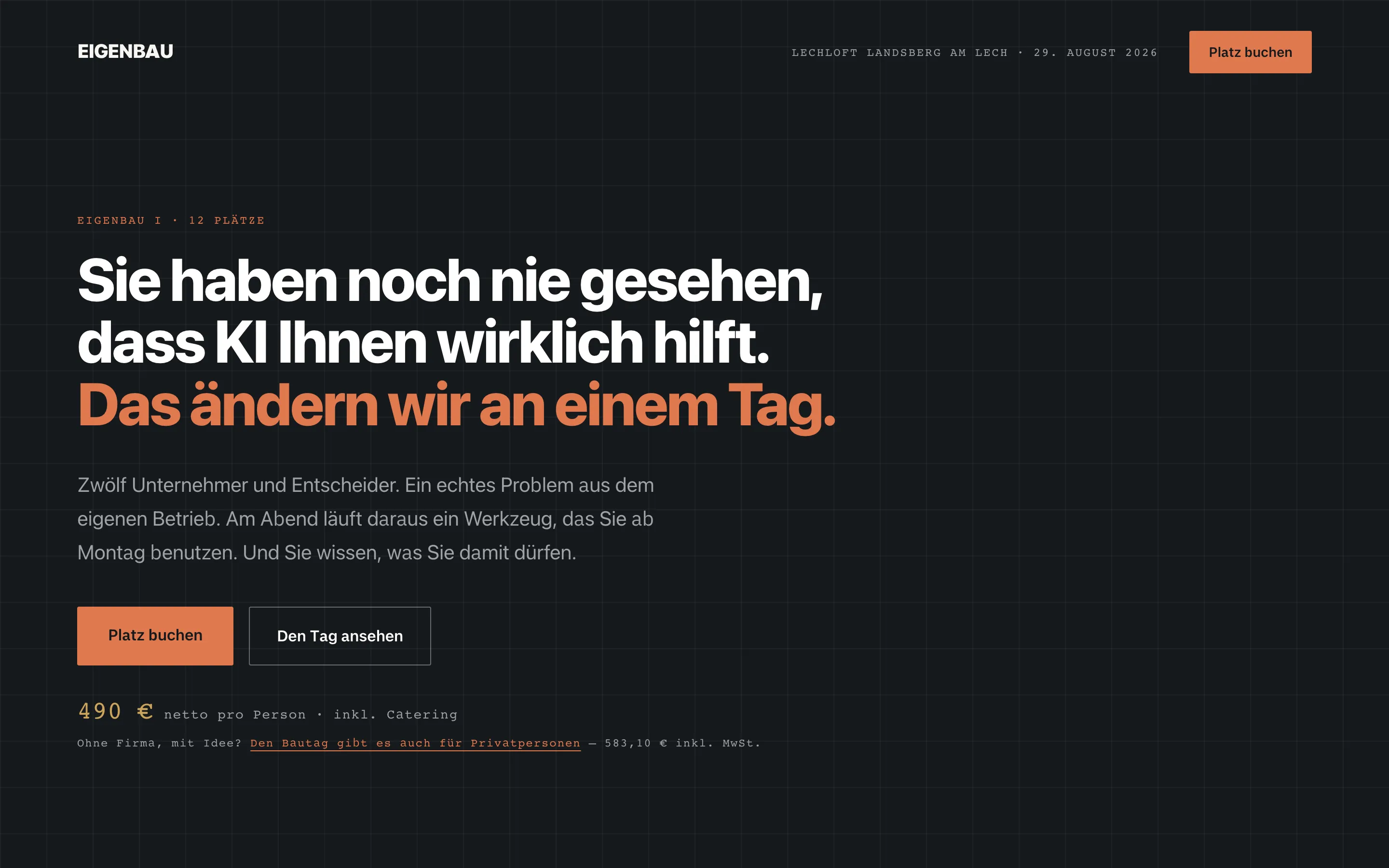
EIGENBAU
Test one process in practice
EIGENBAU is a one-day practical entry in Landsberg am Lech. You work on a real constraint and build a tool for daily work.
- One concrete work process is the focus
- You want to learn from your own case first
- A company-wide assessment is not yet needed
The format does not replace readiness assessment, governance implementation or technical integration into core systems.

This fits in these cases
- A concrete AI, compliance or delivery decision is open
- Relevant teams and documents are accessible
- Ownership for the next step can be assigned
- A limited scope is preferred over an open transformation programme
This is not the right step yet in these cases
- You only need a general trends presentation
- Neither decision makers nor specialists are available
- A certificate or legal opinion is the expected result
- Several use cases need to start without prioritization
Common questions
Which assessment comes first?
It depends on the open decision. If the question is where AI pays off commercially at all, the path starts with the AI readiness assessment. If a specific regulatory requirement is driving it, because a customer or a supervisor is asking for evidence, the optional regulatory module of AI readiness is added. With rising IT cost and no visible cause, the dev team assessment fits. If you are unsure, we settle it within a few minutes in the first call.
Must implementation follow the assessment?
No. Every assessment ends with a standalone result: current state, priorities and a reasoned next scope. You can continue internally, hand it to another provider or do nothing. Implementation is a separate decision with its own proposal and is never attached automatically.
What does the EU AI Act change for us in practice?
The AI Act is Regulation (EU) 2024/1689; the amending Regulation (EU) 2026/1744 has been in force since 27 July 2026. Three points matter for deployers in practice: the transparency obligations under Article 50 have applied to deployers since 2 August 2026, obligations for systems under Annex III apply from 2 December 2027, and in Germany the implementing act has been in force since 29 July 2026, with the Federal Network Agency as central market surveillance authority. The optional regulatory module of AI readiness maps exposure, existing evidence and gaps. It is not legal advice and does not replace review by a lawyer. Timeline status 02/10/2026.
We only use AI in isolated spots. Is this worth it at all?
Especially then. The most common state in established companies is scattered use without an inventory: individual departments work with tools nobody tracks centrally, and nobody can say which use creates value and which creates risk. The readiness assessment makes exactly that inventory visible and sorts it by business value, risk and data situation.
Do you work with our IT department or around it?
With it. Without the responsible people from IT and the business side, nothing survives the end of the project. We bring the approach, the benchmark and decision discipline, your team brings system and process knowledge. At the end, documentation, measurement and ownership stay with your team.
Is EIGENBAU the same as the executive AI workshop?
No. The executive AI workshop is for leadership and ends with a prioritized decision across several initiatives. EIGENBAU is a one-day format in Landsberg am Lech where participants work on a real constraint of their own and build a working tool. EIGENBAU is a separate brand with its own dates and pricing and replaces neither an assessment nor a governance implementation.
Which decision is open in your company?
We clarify whether readiness, compliance, delivery or an executive AI decision workshop is the right first step.
Discuss the value leverThirty minutes. Bring the current use, open decision or regulatory question. We identify the right entry point.